My blog includes a component provided by RevolverMaps which generates a rotating globe in the right hand sidebar** of the screen. Here is a screenshot:
** Note: The sidebar may not appear on smaller devices such as iPhones and SmartPhones.
The red dots on the globe indicate the locations of visitors to my blog. Behind the scenes, RevolverMaps also provides information which includes:
(1) identification of the country from which a visit was received;
(2) identification of any subdivision within the country (e.g. a state, province, etc.) from which the visit was received;
(3) identification of a city, town or other locale within the country/subdivision from which the visit was received; and,
(4) the date and time of the visit.
__________________________________________
This is where my current story begins.
On March 17 some very curious information emerged from RevolverMaps. Early in the morning on that day, my husband Lance routinely checked the blog to see whether RevolverMaps had recorded any overnight visits. As indicated by the following extract from the information provided by RevolverMaps, there was one from the United States, preceded by one from Russia, which in turn was preceded by one from Canada on March 16:
Looking further into the information provided by Revolver Maps, it became apparent that the visit from Russia originated in Moscow:
and that the visit from the United States originated in Ashburn, Virginia:
The times are all Costa Rica times. So, whoever visited from Moscow comfortably did so in the late morning Moscow time 10:38:59 (Moscow time is 9 hours ahead of Costa Rica) and whoever or whatever visited from Ashburn did so at an ungodly early hour of 03:38:59 (Ashburn time is 2 hours ahead of Costa Rica). Who in Ashburn, Virginia would be motivated to look at my blog at that hour?
Lance says it is extremely improbable that the visits to my blog from Russia and the United States would occur down to the second at precisely the same time. He thinks they probably occurred milliseconds apart - first from Russia, then from the United States. He also thinks that the visit from the United States was probably triggered by the visit from Russia.
Speculation: For security reasons, internet traffic from Russia is an issue the U.S. may feel obliged to surveil to the best of its ability. This could dictate that the powers that be (the NSA, CIA, Homeland Security, FBI or whatever agency) have one or more data centers in the Ashburn "hub" to routinely surveil traffic originating from Moscow.
So, what happened? Again speculating:
(1) Upon detecting "traffic" from Moscow to my blog, a data center in Ashburn automatically established its own link to "read" whatever might be attracting Moscow's attention and, with assistance from some form of artificial intelligence (AI), assess whether there might be a U.S. security risk.
(2) It is now more than a month later. Nobody has come knocking on my door. Undoubtedly, when AI read my blog, it did not detect any red flags. Whew! This time, I guess I passed muster.
During March, visits to this blog were received from the following 13 countries:
Each country is followed in brackets by the total number of visits received since records first started to be kept in November 2012.
From the time I started to keep track, the total number of countries and non-independent jurisdictions from which visits have been received remains at 136. Of this number, 13 are non-independent jurisdictions - e.g. Martinique (an Overseas Department and Region of France) from which 1 visit has been received.
_____________________________________________
The following is a summary of weather for March in the area where we live:
The temperatures are shade temperatures. The average daytime high in March this year was significantly higher than March last year (about 3.9°F, 2.1°C higher). At the same time, total rainfall during March this year was significantly lower than last year (about 3.2 in., 88.5 mm lower). Moreover, while there were 10 days with measurable rain in March last year, there was only 1 such day this year.
Last week we joined our friends Diane and John for lunch at Casa Nosstra Bar & Grill in Grecia. I ordered ceviche with avocado - healthy and delicious and perfect for a hot day.
There are lots of recipes on line for ceviche so this would be easy to duplicate.
This is the largest mango tree I have ever seen and it’s loaded with mangos:
It is growing in front of the entrance to the Coopevictoria sugar cane and coffee processing plant, not far from where we live.
We had breakfast recently at the Victoria Cafeteria (next to the plant). Here’s my cafe mocha:
We too have a mango tree, although not as large but we will be enjoying plenty of mangos soon:
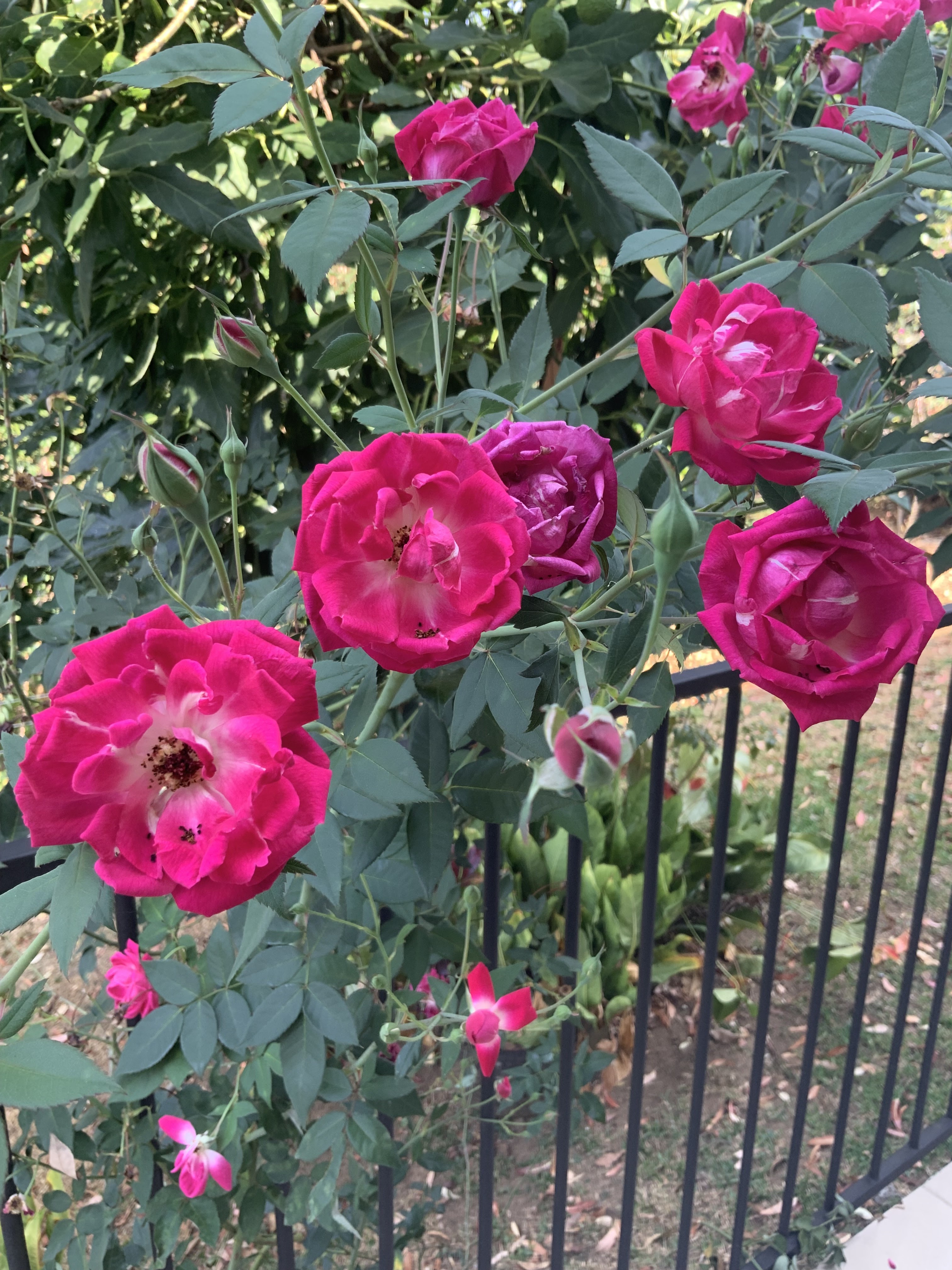
We also have roses:
Limes (not quite ripe):
Orchids:
And an avocado tree (obviously not ripe yet):
Finally, a mora bush (a type of blackberry):
We are early risers and up before the sun. About a week ago, Lance heard some rustling down in our garden. A flashlight revealed some sort of animal digging in a tire planter where I had lavender growing. Eventually the lavender was pushed out, roots and all, and we could see that it was an armadillo causing the damage.
The nine-banded armadillo is common and widespread in Costa Rica, in a variety of habitats, and is active by day or night. They eat fruit, invertebrates, carrion and whatever grows under lavender plants!
We ate lunch at Victoria Cafeteria back in 2022 and have eaten breakfast there several times since then. We recently returned again for another lunch (almuerzo).
First up - drinks. I had the herbal lemonade:
Lance ordered a cold cappuccino, which came loaded with whipping cream on top. I forgot to take a photo.
My choice - salmon with Asian sauce.
Lance opted for shrimp and corvina (a white fish).
As you can see, the portions are quite large and we asked for takeaway (para llevar) so we had two more meals for dinner the next day.
This restaurant is in one of the original wooden Costa Rican houses with a large wrap-around porch. It’s a lovely setting.
It is situated beside the CoopeVictoria sugar cane and coffee processing plant. This is a view of the entrance to the plant:
Here is a short video I made of recently harvested cane waiting to go into the plant:
_______________________________________________
Off Topic
ARCR (Association of Residents of Costa Rica) has published its 2024 March/April issue of its El Residente magazine.
A PDF version of the magazine can be viewed HERE. It contains many articles and references which may be of general interest or to those planning a visit or move to Costa Rica.
During February, visits to this blog were received from the following 14 countries:
Each country is followed in brackets by the total number of visits received since records first started to be kept in November 2012.
From the time I started to keep track, the total number of countries and non-independent jurisdictions from which visits have been received remains at 136. Of this number, 13 are non-independent jurisdictions - e.g. Macau (a special administrative region (SAR) of China) from which 1 visit has been received.
_____________________________________________
The following is a summary of weather for February in the area where we live:
More generally, in the area of the Central Valley where we now live, we have found temperatures to be comfortably mild year round. In contrast to the Pacific and Caribbean coasts, humidity has not been a factor governing our comfort level. So, there has been no need for air conditioning. Similarly, and although the situation can differ at altitudes higher than where we live, there has been no need for indoor heating.
On February 12, 1982, we were married at the courthouse in Vancouver, British Columbia.
So, forty two (!) years later …. we decided on a little getaway to explore an area of Costa Rica that we had not yet seen. We chose Hacienda La Isla (on this link you can select your language preference on the top right bar), a unique lodge in the foothills of the Braulio Carrillo National Park.
We decided to rent a vehicle from Adobe Car Rental here in Grecia as our Subaru needs the front brakes worked on and we are waiting for the parts to arrive from Japan.
Here is our driving route (in blue) with the red pin being Hacienda La Isla.
Although this is a road with lots of tight turns (some of them hairpin) it is a well paved and marked route. It straightens out more after La Virgen. Beautiful scenery. When we stopped to change drivers, we saw these fantastic plants - Gunnera, or “poor man’s umbrella”.
We were using WAZE (free navigational app) but it let us down towards the end of our trip. It told us to turn into a laneway that supposedly led to our lodge but this was wrong. The road was terrible and led to nowhere. Back to the highway and we made a few more wrong moves. Finally I saw a sign that read “Hacienda La Isla Restaurante” so we decided to try this road. The sign was not large and was easy to miss, which we had done a couple of times.
It’s a dirt road and very narrow. I’m glad we didn’t meet a vehicle coming towards us - there was only one area to pull over and let a car pass.
Hacienda La Isla is a unique place with beautiful gardens and walking trails. There is a swimming pool. The buildings are traditional Spanish colonial style. Our room had a king bed. There is no air conditioning and I thought that would be a problem but the large ceiling fan made it more than comfortable and at times almost too cool at night. We could sit outside on the two chairs provided with a table. There was a small safe in a cabinet. Good internet. Bring your own shampoo/conditioner.
Outside our room:
We met the people next to us … they were from Holland.
Temperatures: we were in the rain forest. The first day seemed quite humid. After that we were more comfortable. But it does rain and moisture drips from the trees. Many trees and plants we had never seen before. Same with the bird calls. What I believe was a gray-necked wood-rail strolled by one morning.
Restaurant: breakfast is included and is a typical Costa Rican meal. Food service starts at 7:00 am. There is no menu - but you are asked how you want your eggs prepared. The coffee was terrific … strong! The fresh fruit drink was amazing … made from their own fruits. Dinner starts at 7pm.
The owner of Hacienda La Isla is on site (he is from Belgium) and we met him during breakfast. He greets everyone who arrives using any number of different languages. This is a popular place for European travellers.
Photos from our stay here:
The open air dining area.
The lagoon beside the restaurant.
Ceiling patterns in our room.
Up top there is a room with a balcony.
The lush growth.
On our last day here, we were treated to the appearance of a howler monkey and I was able to make a video:
For our trip home from Hacienda La Isla we decided to plot a different route as shown on the following map:
Coincidentally, and despite a significantly shorter driving distance, the driving time indicated on the route shown is precisely the same (2 hr 23 min) as that indicated for our trip to Hacienda La Isla. This is because much of the trip was through heavily populated areas including the cities of Heredia and Alajuela. However, our actual driving time was substantially greater. We ran into bad traffic conditions, bad weather conditions and bad WAZE conditions.
We chose the route shown because we understood that it would include some spectacular mountain scenery on a part of National Route 32 which is the main highway between the capital city of San José and the port city ofLimón on the Caribbean coast. However, almost immediately after we turned onto Route 32 we came to a dead stop at a bottleneck (B1 on the map) which seemed to include more semi-trailers, buses and other large vehicles than it did automobiles. There we sat for 15 to 20 minutes.
When we began to move, traffic was very slow at first but eventually separated and began to speed up and reach normal speeds. But, this did not last long. Roughly within the circled region on the map there was a dramatic change in the weather. As we climbed up into the mountains it became cloudy, then it became foggy, then it began to rain within the fog - and at times it began to fog up within our car. So much for spectacular scenery - everybody had to slow down.
The next dead stop (B2 on the map) came about 100 meters after we exited the Zurqui Tunnel. There we sat for at least a half hour. There was no oncoming traffic. I have no doubt that traffic behind was backed up not only through the 600 meter length of the tunnel but well further on the other side of the tunnel before the entrance. The reason for the bottleneck never became clear - road maintenance, a traffic accident or whatever.
Ultimately, we exited Route 32, the skies opened up, and the road ahead was clear - or so we thought. Trouble is that my Smartphone pooped out. Somehow, it failed to become fully charged despite having been plugged in all night the night before. Consequence: no connection with WAZE and no ability to navigate through unfamiliar territory. Solution: Park, charge the Smartphone from our vehicle power outlet to get more directions from WAZE and repeat as necessary. We had to repeat 3 or 4 times before we entered familiar territory near the city of Alajuela. We then required no more directions from WAZE to get home.
LESSON: If you are going to go on a trip which relies on WAZE (despite the various foibles that it has), make sure you include your Smartphone (or iPhone) charger within your luggage and that it can be usefully plugged into a compatible power outlet provided by the vehicle you are driving.
During January, visits to this blog were received from the following 12 countries:
Each country is followed in brackets by the total number of visits received since records first started to be kept in November 2012.
From the time I started to keep track, the total number of countries and non-independent jurisdictions from which visits have been received remains at 136. Of this number, 13 are non-independent jurisdictions - e.g. the Isle of Man (a self-governing British Crown Dependency) from which 1 visit has been received.
_____________________________________________
The following is a summary of weather for January in the area where we live:
The dry season is now fully upon us. But, by "us", I mean those of us who live in the Central Valley or Pacific Region of the country and not the Caribbean Region. The difference is that the dry season in the Central Valley or Pacific Region is the rainy season in the Caribbean Region (and vice-versa)
ARCR (Association of Residents of Costa Rica) has published the 2024 January-February issue of its EL RESIDENTE magazine.
APDF version of the magazine can be viewed and/or downloaded HERE. It contains many articles and references which may be of general interest or to those planning a visit or move to Costa Rica.